Archive: Email
|
The 'Archive' gives you an overview of all completed mailings. These include standard mailings (status 'Sent') as well as dialog and campaign mailings once they have been canceled. You can restore a copy of any sent mailing from the archive and use it as the basis for a future mailing, see Restoring an email from the archive.
To demonstrate the function, emma already contains a "Demo-E-Mail" in the archive. The 'Shortcuts' column takes you to the 'Content' of the archived mailing. You can display it in HTML (desktop) and text format, and save it as a PDF file using the 'PDF' button. On the right you will find the icons
In the 'Folder administration' you can create new subfolders, rename or delete existing folders, and so on. |
Sending an archived mailing againDo you want to send a mailing you have already sent once more? Or use it as the basis for the next issue of a newsletter series? Click the 'Copy' icon of the archived mailing you want:
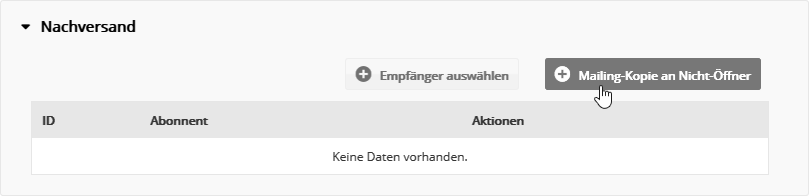
In the pop-up window that follows, adjust the new subject if needed. You can also do this at any time after copying. For template-based mailings, you are also asked whether the copy should be created as a "raw" HTML and text version. In that case, you edit the copy directly in the HTML source code, without template support. Depending on the extent of the planned changes, this requires HTML skills specialized in the particularities of email clients. After clicking 'OK', the view switches from the archive to the current mailing overview. The new copy appears there with the status 'drafted', so you can edit and send it as usual. Late send to selected recipientsYou have sent a mailing and want to send it to a few more recipients, ideally with shared email statistics? Open the archived mailing you want. On the 'Send' tab, click the 'Select recipients' button in the 'Late send' area.
Once you have selected all recipients for the late send, click 'Send now'. This starts the late send. The late sends are recorded together with the previous recipients in the email statistics. Late send to all non-openersDo you want to contact the non-openers of a sent mailing again? Open the archived mailing you want. On the 'Send' tab, click the 'Create mailing to non-openers' button in the 'Late send' area.
Recommendation: For technical reasons*, a non-opener target group always contains some openers as well. To avoid annoying these recipients and to prevent unnecessary unsubscribes or spam reports, you should mark the mailing clearly as a resend:
|

 for managing the mailing, from left to right: